SPECIAL ALERT:
FVAP GOES TO SUPREME COURT ON JUNE 3 |
After years of fighting for survivors' rights to a verbatim record of what happens in court, we're heading to the California Supreme Court. Oral argument in FVAP's original writ petition is set for June 3 at 9 AM at the Ronald Reagan State Office Building, 300 South Spring Street, 3rd Floor, Los Angeles.
For more information about this original writ petition and why the shortage of court reporters is a crisis for survivors of domestic and gender-based violence, visit our website. We'll send a link to watch live the week of the hearing — and we hope you'll join us, even from afar. This moment belongs to all of us who believe survivors deserve justice that happens the first time.
Thank you for standing with us. |
|
|
|
“I wanted to have a powerful tool to help change how women were treated in this society. … So then I volunteered at a battered women’s shelter … I would often stay up all night listening to the women and we did our very first restraining order–one of the women and I–on the kitchen table. … I still remember some of those women and the stories that they told me. I remember doing that [first] restraining order and wanting to help more people.”
—Nancy Lemon, FVAP cofounder, author of Domestic Violence Law |
|
|
|
- Those Who Made Us: Nancy K.D. Lemon
-
Battle of the Bands: Early Bird Tickets Now Available
- Meet a Board Member: Nora Puckett
- Watch FVAP in Action: Upcoming Oral Arguments
- Case Alert: AI Standards in Sheerer v. Panas (2026)
- Advancing Appellate Justice: Lessons from Washington State
-
Fundraising Update: Thank you to all our Sustainers!
- Karma Cinema: Watch Movies, Raise Money for FVAP
|
|
|
|
Those Who Made Us:
Nancy K.D. Lemon |
|
|
|
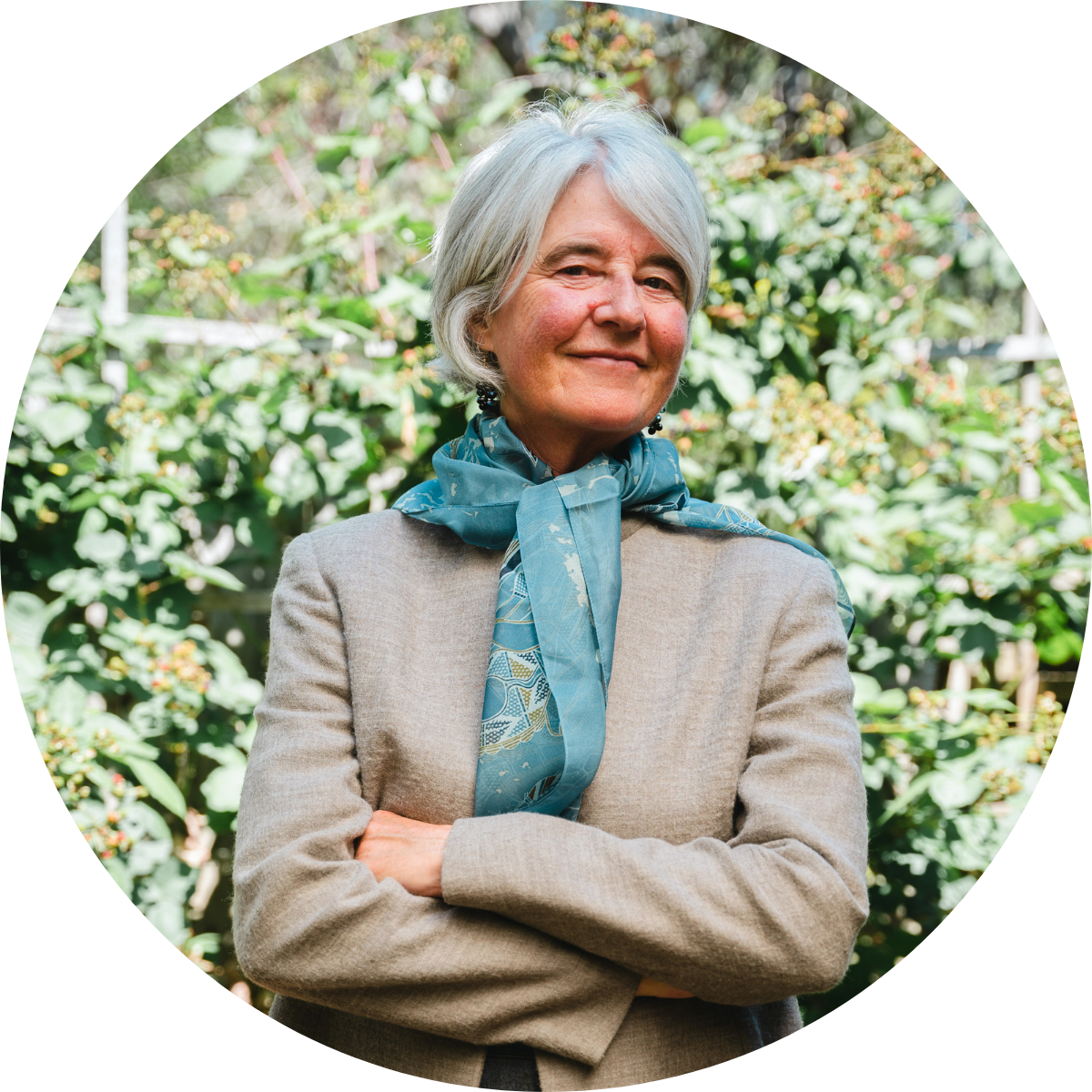
| This month, FVAP takes a moment to honor one of our co-founders, Nancy Lemon.
Nancy's fingerprints are on every corner of domestic violence law in California. A 1980 graduate of UC Berkeley's Boalt Hall School of Law, now Berkeley School of Law, she began specializing in domestic violence legal issues in 1980 — before the field even had a name. By 1988, she was teaching Domestic Violence Law at Berkeley Law, then added the Domestic Violence Practicum, and in 1996 she authored Domestic Violence Law, the first published textbook on the subject. Now in its 7th edition, it is used in law schools across the country. She worked to create or improve California's domestic violence laws regarding law enforcement response, restraining orders, marital rape, and child custody and visitation. She has interviewed untold numbers of survivors, represented hundreds of survivors seeking restraining orders, trained hundreds of judges, law enforcement officers, and advocates, and testified as an expert witness in dozens of civil, criminal, and asylum cases.
She and two of her students, along with a former student, co-founded FVAP in 2012. Nancy served on the Board for seven years, and as FVAP’s Legal Director for the first decade of its existence. In 2013, UC Berkeley honored Nancy with the John and Elizabeth Boalt Lecturer designation, recognizing her decades of service. In 2022 she retired from teaching and working at FVAP. She now serves as a board ambassador for FVAP, her legacy woven into everything FVAP does. This May, we honor Nancy by continuing the work she helped make possible.
|
|
|
|
Battle of the Bands:
Early Bird Tickets Now Available |
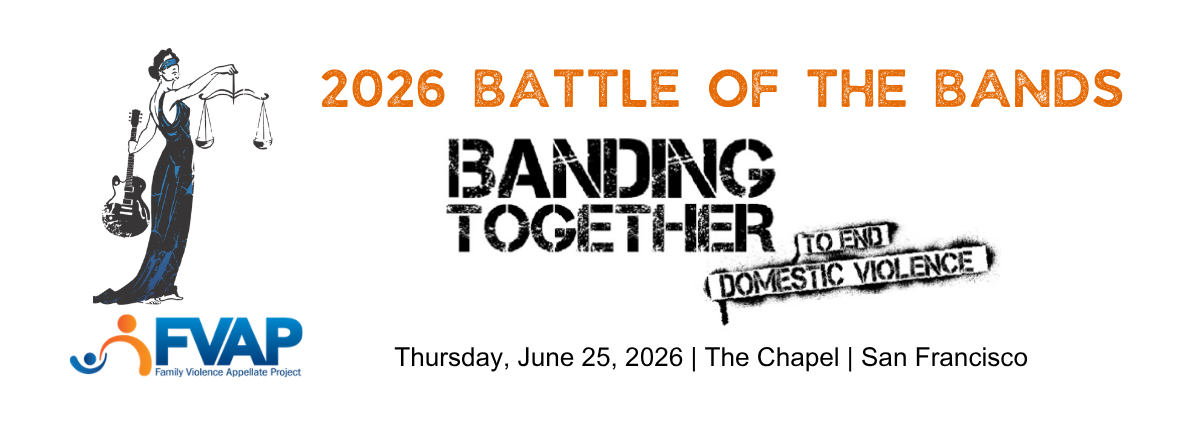
FVAP’s Battle of the Bands fundraiser takes the stage for the 14th time this summer! Watch Bay Area attorneys trade the courtroom for the stage, competing for the title of Best Lawyer Band in the Bay—all to support legal aid for survivors. Every dollar donated counts as one vote for your favorite band! Early bird tickets are available between now and May 31—buy now and enjoy a discount on this epic night of music and impact!
To learn how you can support this fun and mission-critical event, visit our event page. If you are interested in volunteering at the show and enjoy free admission, food, and drink with a backstage view of the event, email dev@fvaplaw.org and we will send you more details.
|
|
| |
Meet a Board Member:
Nora Puckett |
|
|
|
| Why did you join the FVAP Board of Directors?
I first learned about FVAP when a board member at the time told me about the organization and the Battle of the Bands fundraiser. I had a band, and she encouraged me to participate in the fundraiser. Through that, I learned about the organization and its amazing work. Because FVAP works on appeals, its work not only benefits the survivor clients it is representing, but sets precedent for other survivors. It remains a small organization but has a huge impact. I was excited to get the opportunity to be a part of that by serving on the Board.
What’s something you wish more people knew about FVAP?
First, I wish more people knew about FVAP to begin with and how its appellate work is effecting change and at scale. But I also wish people realized that in addition to handling (and winning) cases, FVAP also provides resources and education to family law practitioners, survivors, judges, and others. It may not be able to represent everyone who needs help with the family court system, but it shares its knowledge, learnings, and experience broadly. What's the most rewarding thing about serving on the Board?
The most rewarding thing is knowing I am doing some small part in helping support an organization doing such important work. It is FVAP's attorneys, leadership, and staff that are making a huge difference to survivors in California, and knowing my board service helps facilitate their work means a ton.
What's the best piece of advice you've ever received?
Stay curious. Asking questions and continuing to wonder why things are a certain way is the only way to keep growing and make an impact. |
|
|
|
Watch FVAP in Action:
Upcoming Oral Argument |
FVAP is before the court again this month, and you’re invited to see how we work.
Our client was granted a domestic violence restraining order (DVRO) against her ex-husband based on his decade-long history of abuse, including two further instances of abuse in the last year. The trial court initially granted the survivor sole legal and physical custody of her children, with supervised visitation to her former husband. Less than a year later, the trial court found Respondent rebutted the Family Code section 3044 presumption against awarding sole or joint custody to a parent who has committed abuse in the past five years, and awarded him joint legal custody of their children.
Our appeal challenges the Family Code section 3044 rebuttal finding and resulting joint legal custody order because the trial court: (1) minimized Respondent’s domestic violence history that Family Code section 3044 demands the trial court ground its custody analysis in; (2) failed to properly consider whether Respondent should successfully complete a batterer’s intervention program before exercising custody; and (3) improperly relied on the preference for frequent and continuing contact with both parents to conclude joint legal custody was in the child’s best interest.
The oral argument is scheduled for May 21 at 2 PM, which means our case could go around that time or later in the afternoon (since we'll be on a schedule with other cases assigned for that afternoon session). A link to watch the live stream will appear on the day of the hearing on this website.
Our co-counsel in the case is Debevoise & Plimpton LLP and ADZ Law LLP. |
|
|
|
Case Alert:
AI Standards in Sheerer v. Panas (2026)
|
New case law explains all litigants, including self-represented parties, must follow the rules of court and check any citations, including those found by AI.
In this partially published opinion, the Court of Appeal agreed with FVAP that the trial court erred in calculating our client Anna's child support award by not including opposing party Thomas's bonus income. This part of the opinion was not published and so is not precedential. In the published portion of the opinion the Court of Appeal admonished self-represented Thomas to check the accuracy of any work produced by artificial intelligence (AI). The Court noted that Thomas's briefs included fake and wrong case citations (often called "AI hallucinations") as well as factual assertions with no support in or citation to the record.
The trial court ordered the opposing party to pay our client for child support, but failed to take into account the opposing party's bonus income. There was no dispute that the father was receiving bonuses (and may still be), and no other legally valid reason for the trial court to fail to include all his income when calculating the support amount.
The precedential part of the opinion can be helpful in admonishing all litigants, including abusers, that their filings need to comply with the rules of court and be checked for accuracy to avoid AI hallucinations. Read the full Case Alert. |
|
|
|
Advancing Appellate Justice:
Lessons from Washington State |
|
|
|
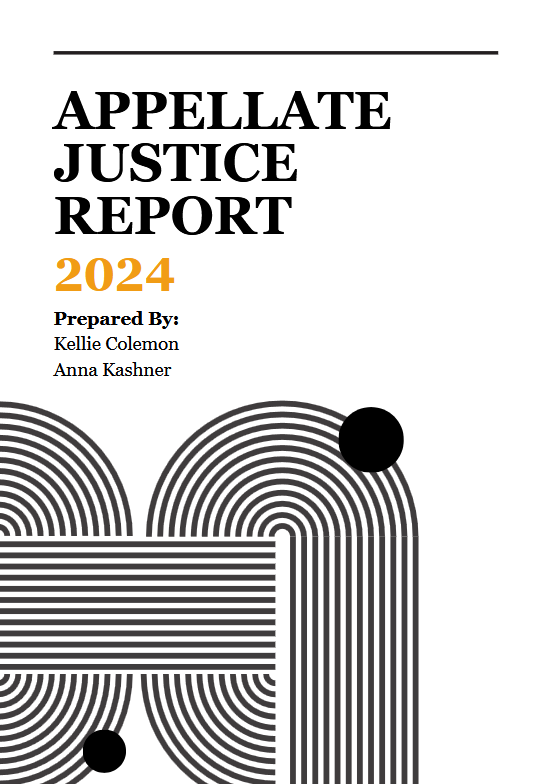
What does it take to make appellate courts truly accessible—for survivors of domestic violence, for people who've been incarcerated, for those navigating the legal system alone and without resources? FVAP set out to find answers. Through our Washington Pilot Project, funded by the Washington Department of Commerce, FVAP collaborated with researchers who closely examined the systemic barriers blocking equitable access to appellate justice—centering the lived experiences of marginalized communities too often left out of legal reform conversations.
The findings are clear: structural obstacles persist, but they are not inevitable. Our report identifies those barriers and offers actionable recommendations for building a more accessible, equitable, and user-centered appellate process. Now, we're looking to California.
The same questions that drove our Washington research demand answers here. FVAP is actively seeking partners—funders and stakeholders committed to systemic reform—to bring this work home and advance justice for survivors and underserved communities across our state. If you're ready to help make California courts more just, we want to hear from you.
Download the full report |
|
|
"Litigants described the appellate process as overwhelmingly complicated, with unclear instructions, rigid rules, and strict deadlines. Many lacked the legal knowledge needed to complete essential steps such as filing briefs or designating court papers. Systems experts noted that even attorneys find these procedures challenging." |
|
|
|
Fundraising Update:
Thank you to all our Sustainers! |
Something remarkable happened this spring: you showed up.
FVAP's spring campaign was a success — thanks to donors like you, we doubled the size of our Sustainers Circle, the growing community of donors whose monthly and recurring gifts provide the steady foundation that survivors depend on. In a year of funding uncertainty, that consistency makes all the difference, ensuring FVAP can offer free legal representation to survivors and their children no matter what.
The circle is never closed. There's always room for one more person who believes every survivor deserves access to justice. A recurring gift of any size — $1, $25, $100 — keeps that promise alive. Become a Sustainer here. |
|
|
|
Karma Cinema:
Watch Movies, Raise Money for FVAP |
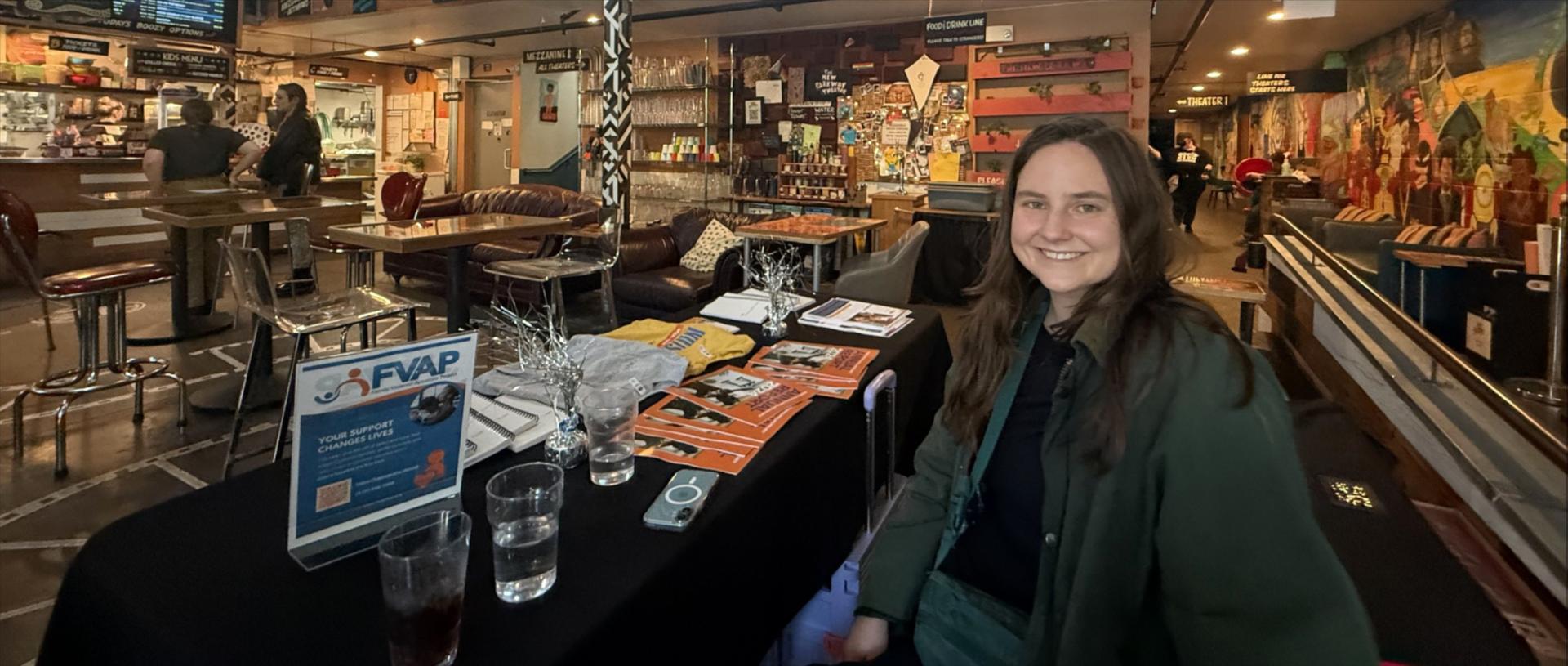
pictured: Lifeline to Justice Staff Attorney Elissa Gray at the Parkway
FVAP is The New Parkway Theater's Karma Cinema partner this May! Every Wednesday throughout the month, moviegoers pay whatever they want for a ticket — and FVAP receives 20% of sales. A night out that does real good.
The New Parkway is at 474 24th St in Oakland — living-room seating , café food, local beers and wines. Check their website for upcoming movies and events. See you there!
|
|
|
|
Our Contact Information
*{{Organization Name}}* *{{Organization Address}}*
*{{Organization Phone}}*
*{{Organization Website}}*
*{{Unsubscribe}}* |
|
| |
|
|