“When we talk about victims of intimate partner violence, sexual assault, stalking, … we often ignore that this abuse can have a severe economic impact on victims. It can cost victims their jobs, their homes, their health, and their insurance – and, in cases of domestic violence, reinforce their dependency on their abusers as a result. This is chilling, and it must stop.”
—Former Representative Lucille Roybal-Allard, D-CA |
|
|
|
- FVAP Listens: How are your local courts implementing FVAP v Superior Court?
- FVAP Advocacy: All the FVAP-backed Bills Signed by Newsom
- Upcoming Oral Argument: Are secret recordings abusive?
- Case Alert: Trial Courts must weigh interests before continuing a DVRO hearing on 5th Amendment grounds
- FVAP in Person: Join us at the CPEDV Conference on November 19
-
Pro Bono Week: Celebrating FVAP's Dedicated Volunteers
- Advisory Board Member Spotlight: Carisa Carlton
- A Lifeline to Justice: Training Seminars Coming in 2027
- Housing Safety & Justice: Free Rental Protection Tools for Survivors
|
|
| |
|
FVAP Listens:
How are your local courts
implementing FVAP v Superior Court?
|
FVAP is conducting an open-ended survey on how courts are and aren't implementing the recent FVAP v. Superior Court Supreme Court decision that requires courts to use electronic recording when a court reporter is not available, and a party cannot afford a private court reporter. Let us know what you’re seeing from your local trial court by completing the survey when you can.
In addition, we’ve created a FAQ to address some questions you may have about how to implement this decision in your court. FVAP is available to answer any questions you have about the decision or to work with you to ensure it is implemented well for your clients. You can contact us at info@fvaplaw.org. Thank you!
|
|
|
|
FVAP Advocacy:
The FVAP-backed Bills Signed by Governor Newsom |
This year FVAP’s Legislative Advocacy program worked on a number of state bills. On September 21, Governor Newsom signed an FVAP co-sponsored bill, AB 1657, which amends the Domestic Violence Prevention Act (DVPA) to close loopholes in local rules and practices that were requiring survivors to provide notice or explain why they weren't providing notice to the opposing party before receiving a decision on their request for a temporary restraining order. These loopholes are incredibly harmful, endangering survivors and discouraging them from seeking the legal protection they need and are entitled to under the DVPA.
FVAP offered substantive consulting on drafting language for several other bills. One is AB 2534, which amends the DVPA to allow survivors of forced marriage to seek protection and to add interfering with court proceedings to the list of examples of coercive control. We also consulted on AB 1875, which now allows courts to waive or reduce the six-month waiting period a spouse usually must wait before they can finalize a divorce, for reasons like domestic violence. Both bills were signed into law by the Governor in September.
In addition, FVAP submitted letters of support related to the budget, asking for additional funding for legal aid organizations, domestic violence agencies, and homelessness services. FVAP supported a handful of additional bills, including SB 1056, which requires criminal courts to issue a protective order for survivors of crimes involving sexually explicit materials, such as revenge porn, which was signed by Governor Newsom in September.
|
|
| |
Upcoming Oral Argument:
Are secret recordings abusive? |
Is taking secret recordings of someone in their most intimate and private moments, including while nude, abuse under the Domestic Violence Prevention Act? For purposes of stalking and harassment, does it matter if the respondent has property or business interests connected to the survivor? Does a family court have the power to grant financial and property-related relief, even if the petitioner could get similar relief in a separate civil law action?
These questions are at stake in an upcoming oral argument in the Fourth Appellate District, Division Three, where FVAP's co-counsel from Morgan, Lewis & Bockius LLP will argue at 9:30 am on Friday, October 23. We hope the Court's decision here will help clarify the scope of family courts' duties and discretion in issuing domestic violence restraining orders. You can watch remotely here.
|
|
| |
Case Alert:
Trial Courts must weigh interests before continuing a DVRO hearing on 5th Amendment grounds |
In a decision published last month, the courts agreed with FVAP and our co-counsel from Gibson, Dunn, and Crutcher LLP in the matter of Irvine v. Irvine, and created a process judges must use if a DVRO respondent requests a continuance based on 5th Amendment concerns. First, the court must decide if there actually is a concern that the respondent will be forced to incriminate themselves. For many DVRO requests, the abuse is not also a crime, so the 5th Amendment doesn’t apply.
If there is a legitimate 5th Amendment concern, then the court must weigh 5 factors to decide if a continuance is appropriate: |
-
The respondent’s 5th Amendment right against self-incrimination and how the respondent would be burdened if the hearing was not continued;
- The petitioner’s interest in proceeding and whether delaying the hearing would be unfair to the petitioner – for example, the petitioner’s witnesses are already at court and the witnesses may not be able to come back on another day;
- The court’s interest in efficiently managing court resources;
- The interests of nonparties – such as additional protected parties who need protection or children who need custody and support orders; and,
- The Domestic Violence Prevention Act’s (DVPA’s) purpose of quickly resolving DVRO proceedings.
|
If these factors do not weigh in favor of the request to continue then the hearing must go forward that day. The Court of Appeal explained, the fact someone is charged with a crime “cannot give him a blank check to block” non-criminal cases about the same facts, justice may require allowing the restraining order case to go forward.
View the full Case Alert for case summary practice tips. | View the Published Opinion. |
|
| |
FVAP in Person:
Join us at the CPEDV Conference on November 19
|
|
|
|
Domestic violence is intimately connected to housing instability and homelessness in California and nationwide. The need for safe housing and the economic support to get and maintain safe housing are two of the most pressing concerns for domestic violence survivors.
California’s limited housing resources have made securing safe and stable housing challenging for survivors, so communities are getting creative in their approach to funding programs and creating housing pathways. The housing track at this year’s California Partnership to End Domestic Violence (CPEDV) conference highlights examples of success, and empowers advocates with the tools to support survivors with housing access and rights — with the hope that the barriers survivors face in seeking safe housing in their communities will be reduced.
FVAP’s own Taylor Campion will be presenting on the Housing Rights of Survivors of Gender Based Violence. Register online here. |
|
|
|
|
Pro Bono Week:
Celebrating FVAP's Dedicated Volunteers |
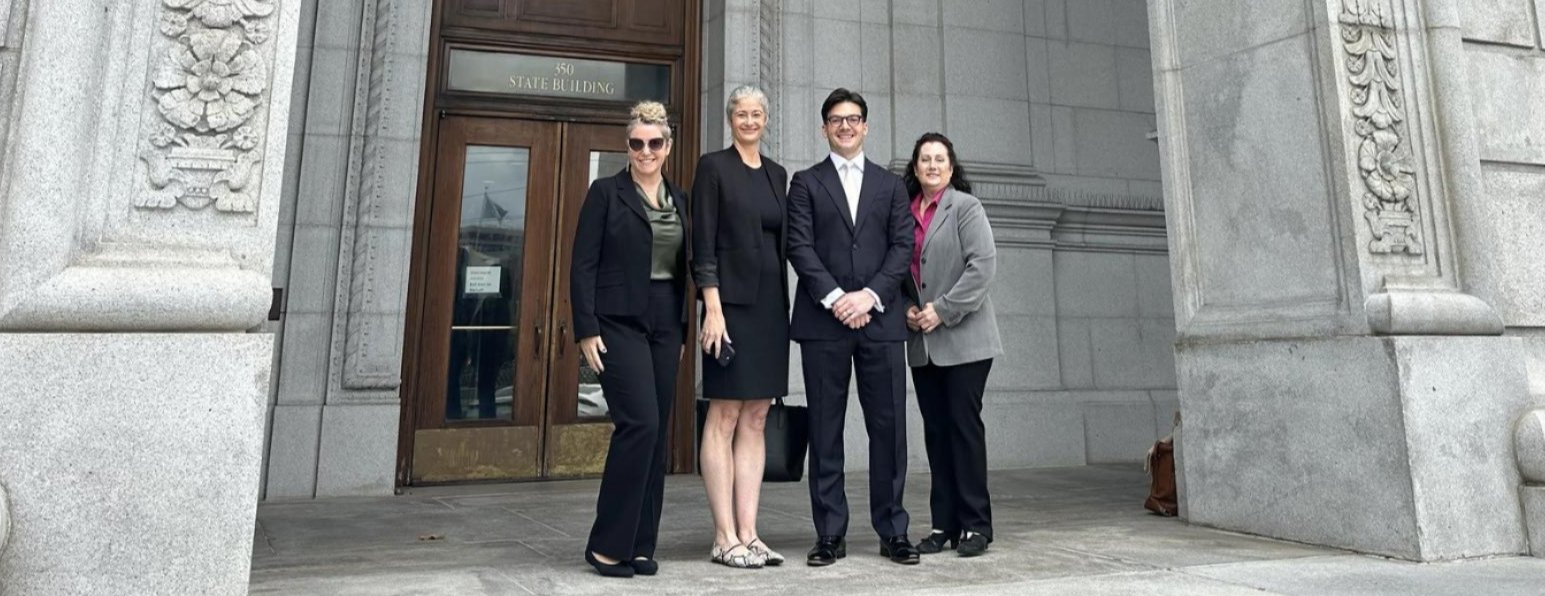
Pictured: (From left to right) Brenda Adams, Bay Area Legal Aid (amicus), Jennafer Tryck and James Rex Lee (pro bono co-counsel from Gibson Dunn) and Jennafer Dorfman Wagner, FVAP |
Family Violence Appellate Project simply could not effect change for survivors of abuse without the dedicated and generous pro bono contributions of lawyers and other legal staff who partner with us to represent survivors in appeals, write amicus briefs, publish opinions, prepare for oral argument, and support our work with research and writing projects! Because of your help, FVAP’s small but mighty legal team has a massively outsized impact, transforming the power of the civil legal system to enable survivors to seek protection, peace, and justice.
Each year, pro bono attorneys and firms more than double FVAP’s annual budget through the gift of their time and expertise. In the last three years, our pro bono network has provided more than 27,000 hours of volunteer representation to survivors, worth an estimated $6.5 million. This support enables survivors of gender-based violence to access the justice they need without worrying about their finances, and maintains the accessibility of the appeals system to all Californians, regardless of income.
Interested in joining the network? Email info@fvaplaw.org for more information! |
|
|
|
Advisory Board Member Spotlight:
Carisa Carlton
|
|
|
|
Carisa Carlton is CEO of Carlton Research, LLC. She is the author of the Codebook for Identifying Coercive Control in Longitudinal Artifacts, written for judges, attorneys, and evaluators.
Ms. Carlton runs Carlton Research as its principal force: a forensic sociologist and cultural & linguistic anthropologist. Her 10+ years of research in coercive control forms her method under pressure: pattern analysis of coercive control conduct measured against peer-reviewed literature, mapped through ethnographic method and statistical reasoning. Factfinders receive evidence they can test.
She is the creator of the Coercive Control Observatory tools for lawyers and nonprofits working in this sector. The tools are free to use and suggestions for additional tools are welcome. |
|
| |
|
A Lifeline to Justice:
Training Seminars Coming in 2027
|
|
|
|
|
FVAP’s Lifeline to Justice initiative will be offering a series of training seminars on emergency writ petitions starting in early 2027. A writ petition is an emergency request for the appellate court to intervene in a case and command the trial court to either do something or stop doing something that’s legally erroneous and harmful. They can be resolved significantly faster than a full appeal, but are inaccessible to many survivors because they are complicated to pursue and many family law attorneys lack the training and expertise to identify and file a successful petition.
California Writs 101, the first module in the series, is an introduction to writ petitions filed in the California Court of Appeal. Training content includes how a writ compares to an appeal; an overview of writ requirements and procedure; and a discussion of leading writ case law. MCLE credits are available, and the module costs $2,500 for 1 hour. Training is available both virtually and in-person.
If you or your firm are interested in learning more about this powerful appellate tool, contact info@fvaplaw.org to be added to our mailing list when the training becomes available, or to schedule an informative session about the coming seminars. |
|
|
|
Housing Safety & Justice:
Free Rental Protection Tools for Survivors
|
Landlords in California are not allowed to evict or punish a tenant because they — or someone else — called law enforcement or emergency assistance if they called to prevent or stop abuse or a crime or an emergency. |
|
|
|
- Abuse means domestic violence, sexual assault, stalking, human trafficking, elder or dependent adult abuse.
- Crime means any misdemeanor or felony crime.
-
Emergency means a situation where you think you or someone else needs immediate help to stop loss or impairment of your or someone else’s life, health or property. Someone having a heart attack is an example of an emergency.
|
|
| |
|
Learn more about tenants' right to call for help in FVAP’s newly updated resource, KNOW YOUR RIGHTS: Tenants’ Right To Call For Help. This resource has an information sheet and a template letter to help tenants understand and assert their right to call for help.
FVAP’s Monthly Housing Call is on the first Wednesday of each month. The call is limited to advocates and attorneys who advocate for survivors of gender-based violence. Join us on Wednesday, October 7th at 2 pm to get your housing questions answered and useful information about housing legal rights. Register today!
|
|
|
|
Right now, so much feels unpredictable—but your support doesn’t have to be. Sustainers Circle members give on a recurring basis, creating a strong foundation that keeps life-saving legal services available to survivors, no matter what’s happening in the world. Your ongoing support gives FVAP the freedom to focus on impact—not uncertainty.
Join the Sustainers Circle and make your support count every day of the year. |
|
|
|
Our Contact Information
*{{Organization Name}}* *{{Organization Address}}*
*{{Organization Phone}}*
*{{Organization Website}}*
*{{Unsubscribe}}* |
|
| |
|
|